By Rev. Dr. Mark Brown
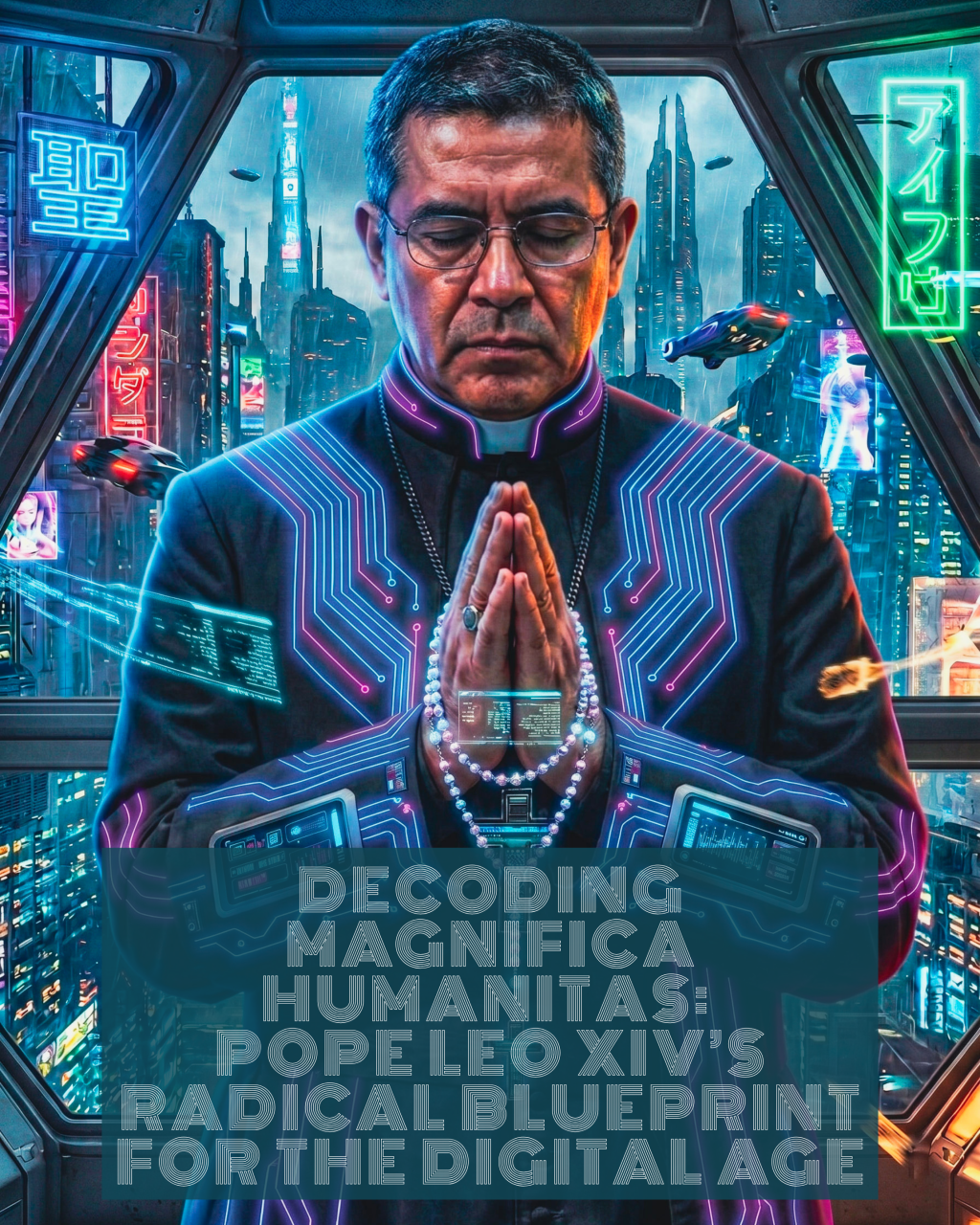
The Vatican has released a document that reads less like ancient theological prose and more like a striking ethical manifest for Silicon Valley, Brussels, and every global citizen navigating the digital frontier. Titled Magnifica Humanitas (“On Safeguarding the Human Person in the Time of Artificial Intelligence”), this Encyclical Letter from Pope Leo XIV marks a definitive moment in modern history.
This is not a token religious commentary on technology. It is a sweeping, structurally sophisticated, and deeply challenging critique of the global technocratic paradigm. Released in May 2026, precisely on the 135th anniversary of Pope Leo XIII’s landmark labor encyclical Rerum Novarum, Magnifica Humanitas bridges two centuries of Catholic Social Doctrine to confront a new kind of machinery: the algorithm.
The core tension of the text is framed through two powerful biblical archetypes: the Tower of Babel and the Rebuilding of Jerusalem. The Tower of Babel represents the technocratic illusion—a project of forced homogenization, where human diversity is flattened into data points, and efficiency is worshiped as a god, ultimately collapsing communication into alienation. Conversely, Nehemiah’s rebuilding of Jerusalem represents the path of communion—a decentralized, collaborative effort where every family takes responsibility for a piece of the wall, building a community that honors human vulnerability and divine alignment.
The Philosophical and Theological Undercurrents
To truly understand what drives Magnifica Humanitas, one must look beneath the surface of its policy recommendations. The encyclical is built upon a profound defense of ontological dignity—the idea that a human being possesses infinite, unconditional value simply by virtue of existing.
Pope Leo XIV targets a creeping cultural sickness: the belief that a person must constantly justify or earn their worth through productivity, intelligence, or economic output. In a world increasingly optimized by AI, the Pope warns that reducing human value to performance metrics inevitably leads to a “throwaway culture” where the inefficient, the elderly, the sick, and the marginalized are discarded as obsolete software components.
The text presents a fascinating philosophical critique of contemporary technological narratives, specifically targeting transhumanism and posthumanism. These movements often view human limitation—aging, suffering, emotional vulnerability—as code bugs to be patched through bio-engineering and algorithmic hybridization.
Leo XIV reverses this premise with startling candor. He argues that human limitation is not a design flaw; it is the very landscape where compassion, authentic relationships, and spiritual depth mature. To eliminate the messy reality of human vulnerability in the name of a perfect machine is to sacrifice the very essence of humanity. The encyclical asserts that true transcendence does not come from a Promethean upgrade of our biology, but from the capacity to love, suffer, and find communion through grace.
The Digital Leap of Catholic Social Doctrine
For over a century, Catholic Social Doctrine (CSD) has evolved by analyzing the shifting structures of human society. Magnifica Humanitas takes the timeless pillars of this tradition and radically applies them to the architecture of the internet and artificial intelligence.
The Universal Destination of Goods… and Data
Traditionally, this principle meant that the physical resources of the earth belong to the entire human family. In a striking update, the Pope expands this definition to include immaterial and cultural goods. Patents, algorithms, cloud infrastructure, datasets, and digital platforms are now classified as collective human heritage. The text heavily critiques the extreme concentration of epistemic and economic power in the hands of a few transnational tech monopolies. Data, the document notes, is a shared product of human interaction and should be managed as a common good rather than private property to be hoarded or exploited.
Subsidiarity vs. Algorithmic Paternalism
Subsidiarity dictates that decisions should be made at the most local level possible, respecting the autonomy of smaller communities. The encyclical brilliantly identifies a new form of top-down centralized power: Big Tech platforms that unilaterally dictate social rules, visibility, and economic opportunities through opaque code. The Pope calls for independent checks, transparency of algorithms, and a revival of local community agency over digital spaces, ensuring that societies are not merely passive consumers of pre-packaged corporate logic.
Solidarity and Restorative Social Justice
Solidarity in the digital age requires recognizing the invisible, often exploited human networks that keep automated systems running. The Pope shines a light on data labelers, content moderators exposed to traumatic material, and children mining rare earth minerals under hazardous conditions in the Global South. Furthermore, social justice is defined not just as an afterthought of wealth distribution, but as a design requirement. The Pope demands that algorithms be audited from their conception to prevent them from automating prejudice, reinforcing structural inequalities, or locking vulnerable groups out of credit, jobs, and public services.
The Illusion of the Perfect Machine: A Critical View of AI
One of the most sharp-witted sections of Magnifica Humanitas addresses the definition of artificial intelligence itself. The Pope cuts through the marketing hype of Silicon Valley, warning against the linguistic trap of equating automated computational speed with human wisdom.
Current AI systems, the encyclical notes, are more “cultivated” than directly built, growing within frameworks where internal processing layers often remain a “black box” even to their creators. Yet, the text reminds us that these models do not possess a body, do not experience joy or sorrow, do not understand friendship, and entirely lack a moral conscience. They simulate empathy; they do not experience it.
The Pope warns against a dual danger in personal and societal AI adoption:
- The Abdication of Judgement: The ease and apparent objectivity of algorithmic answers can easily lull humanity into intellectual laziness, eroding our critical thinking, personal creativity, and capacity to wrestle with complex nuances.
- The Loss of Political Responsibility: By delegating life-altering decisions—such as banking credit, employment hiring, or social welfare access—to automated systems, society creates a veneer of algorithmic neutrality that conceals systemic discrimination. When an algorithm excludes a vulnerable person, empathy is erased, and there is no human agent left to hold accountable.
The document calls for a cultural “disarming” of AI. This means extracting technology from the current arms race of geopolitical and corporate dominance, removing monopolistic control, and subjecting technological deployment to public, democratic oversight.
Truth, Labor, and the Rise of Digital Colonialism
Chapter Four of the encyclical moves from theology into raw, practical socio-political critique, analyzing how the digital transition impacts the foundational pillars of stable human society.
Truth as a Democratic Common Good
The Pope takes a fierce stand against the polarization driven by the digital attention economy. Algorithms that monetize outrage and prioritize engagement over veracity are actively destroying the social trust required for democracy. Leo XIV echoes Hannah Arendt, reminding us that the ideal subject of a totalitarian regime is not the ideological fanatic, but the person for whom the distinction between fact and fiction no longer exists. The text demands a robust ecology of communication, calling for public policy that forces transparency upon platform architectures, protects personal privacy, and establishes a renewed alliance between schools and families to cultivate digital sobriety.
The De-Skilling of the Global Workforce
While tech advocates celebrate AI as a tool for infinite productivity, the encyclical uncovers a darker trend. Current corporate deployments of AI often do not elevate the human worker; instead, they de-skill them, subjecting employees to invasive automated surveillance, eroding their creative agency, and forcing them to match the unnatural speed of machines.
The Pope explicitly states that the pursuit of corporate profit can never justify the systemic sacrifice of human jobs. He introduces a fascinating critique of our current economic metrics, arguing that a society relying solely on Gross Domestic Product (GDP) is blind to the human degradation caused by forced technological displacement. He advocates for complementary metrics that actively measure the dignity of work, equity, and environmental sustainability.
The New Extraction: Digital Colonialism
In a brilliant socio-political critique, Magnifica Humanitas denounces the rise of a new style of colonialism. Instead of extracting physical gold or rubber, powerful nations and corporate elites are now extracting the health profiles, genetic maps, demographic data, and behavioral trends of the Global South. This vital data is compiled under the guise of humanitarian aid or research, only to be used to train predictive models that consolidate geopolitical leverage. The Pope demands that individuals and developing nations retain sovereignty over their data, ensuring that shared knowledge becomes a tool for mutual empowerment rather than an instrument of high-tech subjugation.
The Automated Battlefield: A Rejection of Realpolitik
Perhaps the most urgent and chilling warnings in the encyclical concern the integration of AI into military frameworks. The Pope addresses the development of autonomous weapons systems and completely dismantles the dangerous myth of “artificial moral agents.”
The document states unequivocally that moral judgment can never be reduced to a mathematical calculation. It requires a human soul, a conscience, and an awareness of the sacred nature of the human face. To delegate the decision of life and death to an automated system is a grave moral failure that completely detaches conflict from human accountability.
The Pope lays down non-negotiable ethical red lines for warfare:
- The chain of military responsibility must always be identifiable, transparent, and strictly bound to human agents.
- The decision to use lethal force can never be automated or delegated to an algorithm.
- The moral timeframe required for deliberate human judgment must never be sacrificed for the sake of computational speed or tactical efficiency on the battlefield.
Leo XIV labels the prevailing mindset of Realpolitik—the political “realism” that accepts the inevitability of perpetual war and an unrestrained technological arms race—as a form of historical nihilism and spiritual blindness. He reminds global leaders that peace is not merely a temporary intermission between conflicts secured through deterrence, but a deliberate structure built through justice and an unyielding commitment to international diplomacy.
A Critical Appraisal: Strengths, Tensions, and Blindspots
To assess Magnifica Humanitas with genuine candor, one must view it both as a brilliant moral framework and as a document operating within internal tensions.
The Power of Radical Candor
The ultimate strength of this encyclical lies in its structural intellectual honesty. It successfully reframes the AI debate from a narrow technical discussion about safety alignments into a grand anthropological question about what it means to be human. By expanding classic CSD concepts to data ownership and digital extraction, the Pope provides a sophisticated vocabulary for activists, ethicists, and policymakers worldwide.
Furthermore, the encyclical contains a remarkably humble and unprecedented internal examen for the Church itself. In Chapter Four, Leo XIV exhibits profound institutional vulnerability, openly confessing the Church’s historical blindness regarding slavery, its past compromises with worldly powers, and the modern tragedies of institutional and spiritual abuses within its own walls. By explicitly thanking investigative journalists for bringing uncomfortable truths to light, the Pope models the very culture of transparency and accountability he demands from Silicon Valley.
Legal and Practical Execution Gaps
However, a critical review must note the tension between the encyclical’s lofty moral ideals and the messy realities of implementation. The Pope repeatedly calls for robust international governance, multilateralism, and the democratic regulation of transnational tech giants. Yet, the text offers few concrete paths for how broken, highly polarized transnational institutions can enforce these rules against corporate entities whose budgets and computing power eclipse those of sovereign states.
There is an ongoing risk that the concept of the “universal destination of data” will be dismissed as an abstract theological ideal by an economic system structurally addicted to surveillance capitalism and market competition. Without a clearer political strategy for institutional reform, the document’s beautiful vision of an “ecology of communication” could remain a purely theoretical blueprint.
The Voice of the Catholic Church in the Digital Arena
Why should a global society, highly secularized and technologically advanced, care about an encyclical from the Pope regarding computer science? The answer lies in the unique role the Catholic Church plays as an enduring, transnational moral institution.
The Church does not speak from a desire to reclaim political power or defend a cultural stronghold; rather, it speaks as an expert in humanity, drawing from an uninterrupted repository of wisdom that has witnessed the rise and fall of empires, industrial revolutions, and ideological crises. When the Church addresses AI, it brings a long-term perspective that transcends corporate quarterlies, election cycles, and national boundaries. It stands as a vital counterweight to tech-utopianism, offering a voice centered entirely on the defense of human exceptionalism and the protection of the vulnerable against a reductionist, machine-driven view of existence.
Conclusion: The Rebuilder’s Manifest
Magnifica Humanitas is an extraordinary moral compass for an era caught in a rapid transition. Pope Leo XIV challenges us to step away from the vanity of building yet another Tower of Babel—a grand corporate construction of automated efficiency destined for ruin—and instead join the patient, piece-by-piece construction site of a civilization of love.
The encyclical concludes by pointing to the Magnificat, Mary’s revolutionary song of hope, which boldly reinterprets history through the eyes of the lowly, the hungry, and the oppressed rather than the powerful.
The ultimate importance of this letter is that it restores agency to the individual. It reminds developers, politicians, educators, and citizens that the trajectory of technological evolution is not a predetermined fate to which we must passively submit. Code is written by human hands; data is generated by human lives; and systems are deployed by human choices. Magnifica Humanitas is a brilliant, urgent call to step into the construction sites of our time with courage, to disarm our words, to protect the dignity of labor, and to ensure that the human heart remains the sacred space where wisdom resides.


Leave a Reply