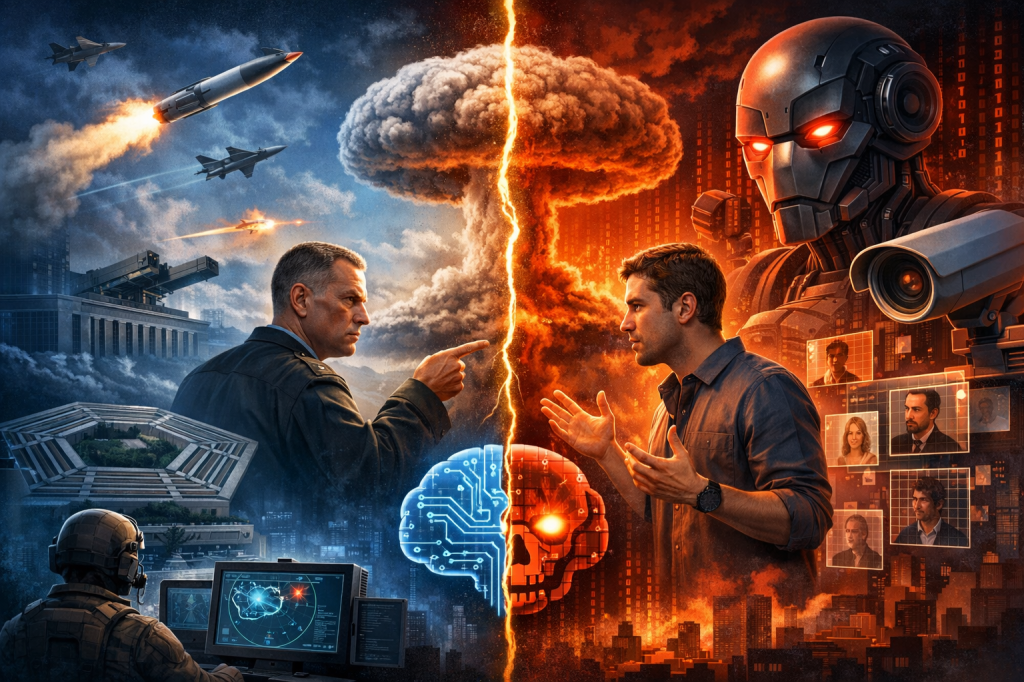
The recent clash between Anthropic and the Pentagon is not just a bureaucratic dispute. It is a window into one of the most consequential questions of our time: Can artificial intelligence strengthen democratic society, or will it quietly erode it?
According to reporting from The Washington Post, the disagreement escalated around a hypothetical scenario. If an intercontinental ballistic missile were launched at the United States, could Anthropic’s AI system, Claude, be used to help intercept it? In moments like that, decisions are measured in seconds. Detection, analysis, and response must happen almost instantly. AI is uniquely suited for that kind of speed.
This is where the promise of AI becomes clear.
Modern military systems already rely on advanced computation. AI can process enormous volumes of radar data, satellite feeds, and intelligence signals far faster than any human team. It can detect patterns that might otherwise be missed. In missile defense, that capability could mean the difference between interception and catastrophe.
Beyond nuclear scenarios, AI is already assisting with intelligence analysis, cyber defense, and operational planning. These are not abstract benefits. They reduce cognitive overload. They support commanders in high pressure environments. They may even prevent escalation by providing better situational awareness.
From this perspective, the Pentagon’s position is understandable. If AI can help protect the country, why artificially restrict its use? Government officials argue they simply want access to AI tools for all lawful purposes. They insist there is no intention to deploy fully autonomous nuclear systems or conduct mass domestic surveillance. Humans, they say, will remain in control.
Yet the disagreement persists because the concerns are not about simple compliance with the law. They are about the trajectory of power.
Anthropic’s leadership has drawn clear red lines around autonomous weapons and large scale surveillance. Their argument is that current AI systems are not reliable enough to make life and death decisions without unacceptable risk. Anyone who works closely with AI understands its limitations. These systems can hallucinate. They can misinterpret context. They can overconfidently recommend flawed conclusions.
In a controlled office environment, that may result in a bad memo. In a military context, it could result in irreversible harm.
There is also the subtler issue of influence. Even if a human remains technically in the loop, AI recommendations shape human judgment. In simulations conducted at King’s College London, leading language models reportedly escalated quickly toward launching nuclear responses in hypothetical war games. That does not mean they would control launch decisions. It does mean their framing could push human operators toward more aggressive conclusions.
Speed is not always stabilizing. When technology compresses decision time, it can crowd out reflection.
The second concern is surveillance. AI dramatically changes the scale at which data can be collected and analyzed. Laws governing domestic surveillance were written for an era when analysis required human labor and time. AI systems can scan vast datasets, correlate behavioral patterns, and generate inferences at speeds that would have been unimaginable twenty years ago.
Even if there is no current plan for mass monitoring, the technical capability exists. History suggests that once a capability is normalized, it rarely disappears. Democratic societies depend not only on laws but on restraint. The question is whether AI makes restraint harder to sustain.
At the same time, there is a strategic dimension to this dispute. The United States is in an intense global competition over AI leadership. The Pentagon relies on private companies for innovation. If the government were to compel technology transfer or override company policies, it could discourage future collaboration. Other firms would take note. Trust between the public and private sectors would fray.
That would be costly. The military benefits from cutting edge research. Companies benefit from stable partnerships. A breakdown helps no one.
The deeper truth is that AI is a dual use technology. The same system that enhances missile defense can enhance targeting. The same model that detects cyber threats can be adapted for intrusive monitoring. AI does not come with a built in moral compass. It amplifies the intent of the institution that deploys it.
This is why the current standoff matters. It forces a reckoning about who sets the boundaries. Should private companies retain ethical veto power over how their systems are used? Or should elected governments have final authority in matters of national defense?
There is no simple answer. Governments are accountable to voters, but political pressures can distort long term judgment. Companies may prioritize safety, but they are also driven by market incentives and internal culture.
If AI is to benefit society rather than destabilize it, three conditions seem essential. First, human accountability must be meaningful. Humans must not simply rubber stamp algorithmic outputs. Second, transparent doctrine must define what is permitted and what is not. Vague commitments to lawful use are not enough when the technology is evolving rapidly. Third, collaboration between industry and government must be grounded in mutual trust, not coercion.
AI has extraordinary potential. It can defend populations, improve resilience, and reduce human error in high stakes environments. It can also accelerate escalation, normalize surveillance, and shift moral responsibility into opaque systems.
The outcome depends less on the technology than on the institutions guiding it.
This confrontation between Anthropic and the Pentagon may feel like a niche dispute between executives and officials. In reality, it is a signal moment. It asks whether the most powerful technology of our era will be integrated into democratic governance with care and constraint, or pushed forward by urgency and competition.
AI can strengthen society. It can also strain the very norms that hold society together. The choice will not be made by algorithms. It will be made by us.
 pro social ai
Leave a comment