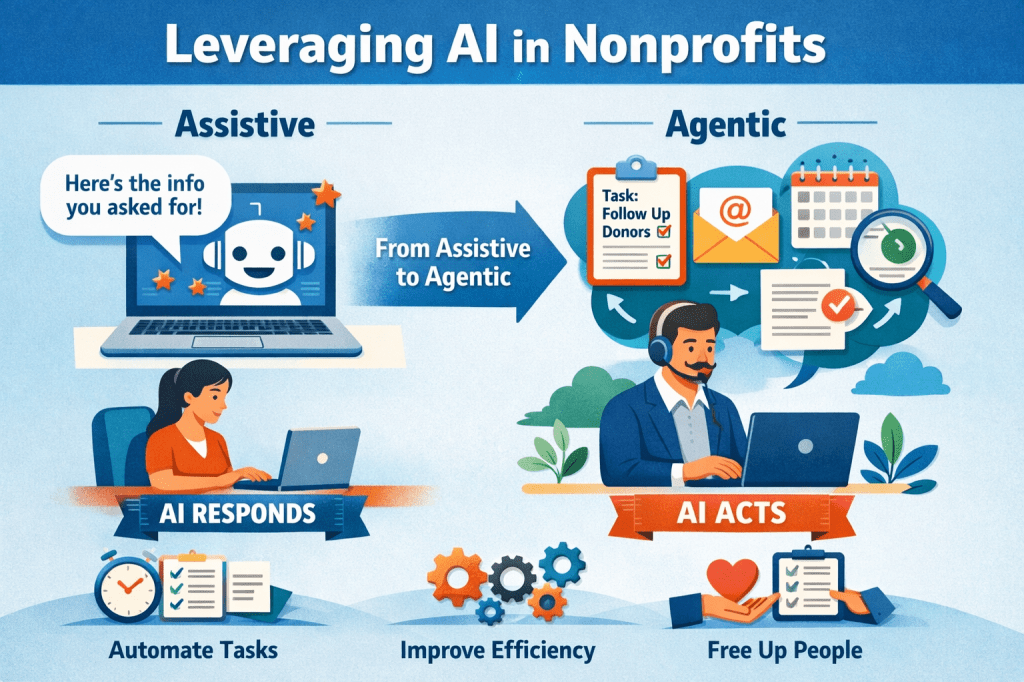
It would not be too much of a stretch to state that AI is now firmly a part of non-profit organizations. Whether in small ways through correcting grammar, to drafting complete grant submissions, AI is everywhere! Curiously, though, this is actually still quite a basic form of AI, known as assistive AI. It is certainly helpful, responsive, yet largely passive. Assistive AI is on its way out, and agentic AI is taking its place. Assistive tools wait for you to tell them exactly what to do. Agentic AI, by contrast, can take initiative, handling tasks on its own within clear guardrails instead of needing constant direction. Agentic is a lot more independent, a more mature version of what we have now.
Think of it as a highly disciplined operations assistant that never forgets and never gets overwhelmed. One that works 24/7 without complaint. Sounds amazing, huh?!
Why This Matters for Nonprofits
Nonprofits rarely fail because of bad intentions or poor strategy. They struggle in the space between knowing what should be done and having the capacity to do it consistently. Every nonprofit I have been involved with has overworked staff. And despite good intentions, such staff forget tasks, which can lead to inefficiencies and lost opportunities. Agentic completely removes that huge issue.
It can identify and fix:
- Missed donor follow-ups
- Stalled client cases
- Late grant reports
- Untracked board commitments
- Strategic plans that quietly fade
Agentic AI is uniquely suited to close this gap.
Is This Doable Today?
Though young, the technology is available. But it requires some thought, careful planning, and resisting the temptation to deploy a single autonomous AI across the organization.
Much more useful is to build small, bounded agents tied to specific workflows. So Agentic AI works best within the nonprofit space when it:
- Has a narrow mandate
- Operates inside existing systems (CRM, case management, grants tracking)
- Requires human approval at key decision points
- Logs and documents everything it does
And this can be achieved today through:
- Modern AI language models such as ChatGPT or Gemini
- Workflow and automation tools (eg, Formstack and Zapier)
- Existing nonprofit software platforms
- Clear human-in-the-loop guardrails
A Simple three step how to
To implement agentic AI, nonprofits typically combine three mature components:
1. Your Existing Systems (Source of Truth)
This includes:
- CRM systems
- Case management platforms
- Grant tracking tools
- Email and calendar systems
Agentic AI does not replace these systems. It reads from them, monitors changes, and acts based on what they contain.
2. A Workflow or Automation Layer
This layer:
- Watches for triggers (missed deadlines, inactivity, status changes)
- Manages sequences of actions
- Enforces approval steps
- Keeps logs for accountability
3. AI for Interpretation and Drafting
AI is used to:
- Interpret status and patterns
- Draft summaries and suggested communications
- Explain the next steps
- Prepare briefing notes
Importantly, AI prepares—humans approve.
the big EG
Example 1: Donor Stewardship Agent
Goal: “Ensure no donor goes more than 30 days without a follow-up.”
What the agent does:
- Monitors CRM activity daily
- Flags donors with no contact logged in 30 days
- Prepares a donor briefing note
- Drafts a suggested follow-up email
- Routes it to staff for approval
- Logs the action
What it does not do:
- Send emails without approval
- Decide who should be asked for gifts
- Change fundraising strategy
Example 2: Grant Compliance Agent
Goal: “Ensure all grant deliverables are met on time.”
What the agent does:
- Tracks reporting deadlines
- Pulls program data from internal systems
- Draft report sections
- Flags missing data early
- Alerts leadership when risk appears
The result is not automation for its own sake, but fewer compliance failures and less staff burnout.
Example 3: Case Management Support Agent
Goal: “Prevent client cases from stalling.”
What the agent does:
- Tracks required documents and deadlines
- Flags inactive cases
- Suggests next administrative steps
- Prepares concise case summaries
Agentic agent handles coordination and follow-through. It acts like an operational amplifier, in support of the staff.
A Simple Rule of Thumb for Application
If a task is:
- Repetitive
- Rule-based
- Time-sensitive
- Easy to forget
- Emotionally neutral
It is a strong candidate for agentic AI.
If a task involves:
- Trust
- Discernment
- Ethics
- Relationships
- Lived experience
It should remain human-led.
and now my final word
Take a good, hard look at the possibility of using agentic AI. Though we are in the very early days of this technology, we can still use it to:
- Increase reliability without increasing headcount
- Reduce burnout caused by administrative overload
- Scale impact without scaling bureaucracy
- Focus human effort where humans matter most
This is not about replacing people. It is about freeing people to do the work only people can do.
Let me know what you think!
In all things prosocial-ai,
Dr Mark Brown
 pro social ai
Leave a comment